

By then, it was late April, and time had run out. My SBA loan was mature. A payment was due on May 1, 2012, and I didn’t have the money.

I didn’t write this prayer in my journal, but standing in the middle of my bedroom, arms lifted, I said these words out loud.
Father,
I don’t care if I ever work again.
I don’t care if I lose my house.
I will never stop loving you.
I will never stop upholding my husband.
I will never stop loving my children.
I will never stop honoring my mother.
I choose you above all else.
I knew God could deliver me from the coming catastrophe. But if not, my faith did not rely on what He did, or did not do, for me. He was my God, and I could serve him no matter what.
Times like those are often called a dark night of the soul. It is when the Lord takes his pruning shears and cuts into your soul so deeply that the bleeding feels like dying.
I felt like I was dying because, in my heart, I heard my colleagues laughing at me. “Who does she think she is now?” In my mind, they were right. Who was I if I could not think for a living?
Thankfully, the storm ended before I succumbed to its misery. On May 1, 2012, my consulting partners contacted me to subcontract as a requirements coach, helping business analysts gather and write use cases. I had long lost faith in this method, but it was a paying gig that preserved my independence. It was also remote. I could give lectures and advice to analysts online, which gave me a lot of time to focus on what survived the pruning.
The NeighborNetwork didn’t make it out. There was no way I could produce Neighborhood Clouds without substantial security and system testing, both of which cost a lot of money. Money I obviously was not getting.
MedEzer didn’t make it out, either. We had a very successful meeting with an intermediary on December 1, 2011, and they scheduled us to return and present our idea to executives. On March 1, 2012, we met with a director and CIO, but everything went wrong during the presentation. The prototype didn’t work, and we couldn’t answer questions about our competition. We were out for the count.
And, strangely enough, my life insurance policy didn’t make it out. I had a substantial policy that I had kept up for over fifteen years. I missed one quarterly payment, and just like that—it was gone.
So, what did I get to keep?
In June 2011, I developed People First-Process Second, and gave my first public TechFest presentation on that topic. It was a strengths-based software process system intended to differentiate my software development company, Salt Productions, from the competition. However, Salt Productions no longer had software to develop.
Or did it?
With God’s guidance and grace, I pursued the relationship with my consulting partners, working with them to build an agile practice offering for their firm. By November 2012, I had developed and delivered four agile workshops for their employees at no charge. I also joined Pitt Agile, a local meetup, and presented at the TechFest conference again.
I asked, “Now, Lord. Now that this has been completed... what do I do next?”
He answered. “WAIT. ENJOY YOUR LIFE, LOVE YOUR FAMILY, SERVE YOUR CHURCH. WAIT FOR THE NEW YEAR.”
In January 2013, I helped my consulting partners win a contract to develop a software process for an organization in Tennessee, so they asked me to lead the effort. It was finally my chance to put People First-Process Second to the test, and if you ever had a job, it’s easy to imagine what that could look like. It’s primarily about roles at work, i.e., deciding up front who gets to make which decisions.
People First-Process Second is based on the premise that caring, not a job title, is the motivating factor in optimal decision-making, and there are nine optimal decision-making perspectives in software development.
Business Value develops products that create revenue to support business goals.
System Value describes systems that deliver requested business value.
Process Performance executes project schedules on time and on budget.
Application Architecture designs maintainable, reusable, and understandable systems—you get the picture.
System Quality makes sure systems are secure, trustworthy, and perform as expected.
Development Process makes sure team members have what they need to do their jobs well.
Implementation develops source code that is free from defects, easy to understand and change, and as efficient as possible.
Technical Architecture selects/maintains capable computer technologies.
User Experience makes sure users are as productive as possible using systems in their environments.
The People First web application displayed the results of a brief questionnaire.
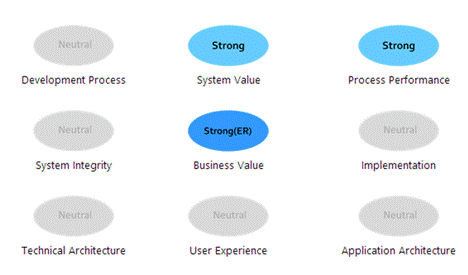
The team member above cares about System Value, Process Performance, and Business Value. In addition, they are Strong(ER) in Business Value, meaning that as their Agile Coach, I could not only count on them to make reliable business decisions, I could also depend on them to lead others in vital decision-making.

Back to putting my idea to the test in Tennessee.
I was part of a four-member team composed of traditional roles: a project manager, a customer relationship manager, a software process designer (me), and a requirements analyst. The requirements analyst answered the People First-Process Second questionnaire. The results revealed that he cared about more than just System Value. He also cared about Application Architecture, which meant he hoped to be responsible for design decisions—the decisions I was planning to make. The decisions I was looking forward to making.
What was I going to do?
I empowered him to make design decisions, of course. With little to no guidance, he did a great job, and when the contract was over in December 2013, he told me the Tennessee engagement was the best engagement he ever had.
That was all I needed to know.
If you have just joined us and are wondering what this story is about, start from the beginning. I promise it will all make sense.