

They said I needed new screen layouts, new colors, new navigation, and a brand new architecture to support it all.
That meant I had to rewrite the entire application. Again.

I pressed hard into the rewrite. Free online classes got me up to speed on the new architecture. Then I coded each user story again, taking no breaks. Even when Noble and I visited Barbados in February for our 25th wedding anniversary, I spent the sweltering hours of each day coding in the cool shadows of our condo. I finished the improved version in early spring, updating the user experience and architecture, and adding the feedback I received in 2016 as new features.
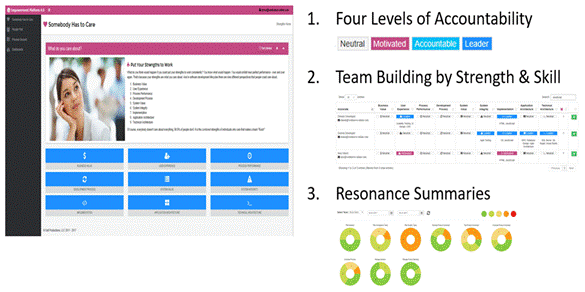
For one, the manager’s role changed. They could already build teams using strengths. Now they could use both strengths and skills to figure out who should be on which team. I also removed access to individual resonance ratings. Instead, I created a coach role with access to combined ratings, much like the ones I shared with the PMO Leader. Besides using the role to manage my teams, I planned to use the coach role in the future for agile coaches trained in People First techniques.
The People First assessment also changed. Drastically. The previous assessment was no more reliable than asking a team member outright if they cared about a particular perspective. To counteract their self-bias, I added two additional levels of motivation. So, when team members selected a perspective they cared about, it turned pink, meaning they were motivated. If more than half of the team agreed, it turned light blue. That meant they were accountable. Later, an agile coach could change it to dark blue when the team member achieved leadership capabilities in that perspective.
During all those months of coding, I was also pressing hard into Bible school. Enrolled since September 2011, I took one class per term, but in 2017 I started taking two or three. At that pace, I was on track to graduate in May 2019.
One class I signed up for that spring proved to be both practical and prophetic. In it, we discussed in dogged detail how painful childhood experiences cause us to miss our calling. It was true. I never got over being told Black girls could not be astronauts. Sure, that was the sixties, and there were no Black astronauts then, male or female—at least none we could see.1 The unjust exclusion devastated me, and it set a precedent in my soul.
Do not reach for things that are not yours, Black girl.
I kept reaching for new customers anyway, but my grasp returned nothing but air. Thankfully, the online marketplace renewed their yearly subscription, but other than that, there were no prospects for continued growth. My business consultant introduced me to a few more people, but none showed interest, even with the new interface and features. We began meeting less and less, leaving me to search out customers on my own.
I presented the platform to an old friend who was the CTO of a local startup. He and his analyst were kind and attentive and gave me great feedback, but no sale—even though I asked for it. He said it was too expensive.
I showed it to a colleague. I didn’t realize he was between jobs. “Sorry,” he said.
After demonstrating it to another colleague, a Black female software engineer, she suggested I would get better traction in Atlanta. Atlanta? I couldn’t go to Atlanta.
I contacted the owner of the consultancy that staffed developer positions for the online marketplace. They were already familiar and happy with the People First platform. Surely they would be interested in using it with their other clients. No, they were not.
I set up a videoconference with a manager from a company in New York. “We can’t use that here,” she said.
By late spring, my hands were still empty, so I put my heart into preparing for the TechFest in June. My presentation was called Somebody Has to Care! A Disruption to Traditional Cross-Functional Collaboration; it represented twenty-plus years of observation from the trenches of software development, answering the question so many in the industry were asking. How do you diffuse process improvement in software development organizations? My answer. Put People First.
First, I presented the problem. It takes many kinds of people to develop software, but they don’t understand each other’s points of view. They often end up hating each other. Second, I explained the nine perspectives and tested them right then and there with the attendees as my subjects.
My lovely young assistant passed out Caring Cards to people who resonated with the descriptions. Then, I presented three agile activities, and after each one, I asked everyone who cared about the activity to stand up. Showing the corresponding perspectives, I asked those standing what cards they held.
Everyone’s mouths dropped open.
Out of approximately one hundred attendees, only one person possessed a card that did not match. That was not the end of the presentation, though. I further illustrated how I used these methods in not one but three organizations—all with positive results.
The audience clapped, and many came up afterwards to congratulate me personally. I was so encouraged. Was I finally going to get the contracts I so desperately needed? It certainly looked promising, especially when a woman from Red Chair Pittsburgh asked for my card.2 Shortly after that, she introduced me to the CEO of a non-profit to end food waste. They wanted to support their grass-roots food distribution network with a mobile software application, but they were struggling to get it off the ground.
By mid-September, I was their pro bono agile coach, using People First to empower their people to reach their goals—together. So, even with the crushing disappointments, 2017 ended up being nice after all. Especially due to the Bible school class—the one that was practical and prophetic. It was practical because it helped me understand why my disappointments were so devastating. It was prophetic because God finally revealed my name, the one I had been attempting to discern for decades.
The six of us were in the classroom that evening, including our Bible teacher, who stood before the well used whiteboard that clung precariously to the front wall. She had worked hard to cultivate community amongst us, and it worked. We cared about each other. We trusted each other, and that night, on the last day of the term, she told us it was time to ask God to disclose our real names—our true characters. Our fervent prayers saturated the room until it practically pulsed with our praise.

Then I heard it, a small voice deep within my spirit. “Your name is Mishalariah.” I ran from the classroom in shock and fell sobbing on my face in the hallway.
I do not deserve such a name!
It is so much weightier than Misha, which means “Who is like God.” Are not we all made in his image? Or Mishala, which means dream or desire. Anyone who knew me would tell you I was a dreamer. However, adding -iah to the end of a name implies God’s intimate involvement; like Isaiah means “God Saves,” and Zechariah means “God Remembers.”
Mishalariah means, “God Dreams.”
If you have just joined us and are wondering what this story is about, start from the beginning. I promise it will all make sense.
My Mom told me this when I was about 11. She was trying to protect me. It was the reality of her world. Born in the era of Jim Crow, she was made painfully aware of the unjust limitations placed on us. I took her to see Hidden Figures when it came out in 2016. She told me that she wished she had known.
Red Chair Pittsburgh is a non-profit organization focused on the participation of women in computer science. Their research revealed that women leave their highly technical jobs mid-career, twice the rate of men, resulting in hundreds of thousands of dollars in lost income.