

I was at death’s door.

In January 2010, I was in and out of the hospital twice. The first time was for a blood transfusion, the second for a hysterectomy, a major operation that put me in bed for six weeks.
I didn't get much coding done, but I did seek God. On February 17, 2010, I wrote:
"Father God! I have been seeking You all day... through prayer, reading scripture, reading writings from Your great teachers, listening to Your teachers on TV... I have been seeking You because I need to hear from You. I need to feel Your presence. I know that You see me, Lord. I know that You have taken care of my needs... but Lord... is there anything that I need to be doing?"
"What are you doing, Misha?"
"I am resting & healing from major surgery. It has been 3 weeks since my hysterectomy. My doctor has recommended—no, ordered rest for 6 weeks. I am conforming to her request. This is what I should be doing.
(I am) working on T-Communications/Lifetime website/application according to the 6/2010 project plan. Lord, I can't give up on this. This is the backbone of the dream/vision for a better tomorrow. And it's my major contribution to influence using my tenacity and excellence of production. I can't not do this...
(I am) developing plans for SALT & T-Communications. I am doing this because my business counselors recommended that I do this in order to be better able to seek funding (loans, venture capital). I am doing this because I need to know what to do when funding becomes available. I want to make sure the plans are profitable so there will be no loss. I am doing this because You told me to be prepared...
Lord, I do spend a little time each day resting, developing, and planning. Is this all I need to do... or is there more... or should I be planning more quickly... or should I be looking for work... What about the contract with [Company]? I already told them I wasn't qualified. Am I? Would I be a blessing to their organization? Or would I be wasting their time and money?
Should I be planning more quickly?"
"Do you have a plan for the plans? If not, how will you ever get done? Set goals for your planning. Make an appointment with a bank & with a venture capitalist. [Name] will help you if you share your planning with her. Meet with her again. Attack the paperwork and get it over with."
"Should I be looking for work?"
"Misha, you have outsourced this activity. Let them do their job. They need the income from you just as much as you need the income for yourself (and your church). Make sure you make the most of this opportunity. You will be back to work before you know it and your time will be much limited."
It wasn’t long before my consulting partners got me a short-term contract with a healthcare organization. The developers on the project were working on a web-based portal and wanted to use Scrum, an agile software development process that had recently gained popularity due to its simplicity.

Unlike the Rational Unified Process (RUP) with its many phase-based and role-based procedures, Scrum has only four activities, 1) the daily Scrum, 2) a Sprint planning session, 3) a Sprint review, and 4) a Sprint retrospective. It also has only three roles, 1) the development team, 2) the product owner, and 3) the scrum master.
However, the project leaders did not want the developers to use Scrum. They wanted them to adhere to their traditional approach, but the developers dug in their heels and refused to conform. That’s where I came in. They wanted me to engineer a compromise that they, the project leaders, and the developers, could agree on.
I didn’t think I was qualified. I had never used Scrum before. However, it was easy to learn, and after a while, I had to concur—it was much more efficient than RUP. Teams always struggled with RUP, especially the use cases. Use cases are a software engineering artifact, and so they are inherently abstract, like analysis and design. But shouldn’t analysis and design be done during development? It was user stories that helped put that effort where it belongs.
User stories are written like this: As a <user type>, I want to <do something> so that I can receive <some business value>, and can be developed and tested in a single iteration—usually two weeks.
For example: As a homeowner, I want to be able to turn my house lights on and off when I am on vacation so thieves will be deterred from breaking in.
Unfortunately, it takes a lot longer than two weeks to develop and test a story like that. It has to be broken into smaller pieces that can be developed over several iterations. That was why managing remote automation devices was giving me so much trouble. The effort was just too big.
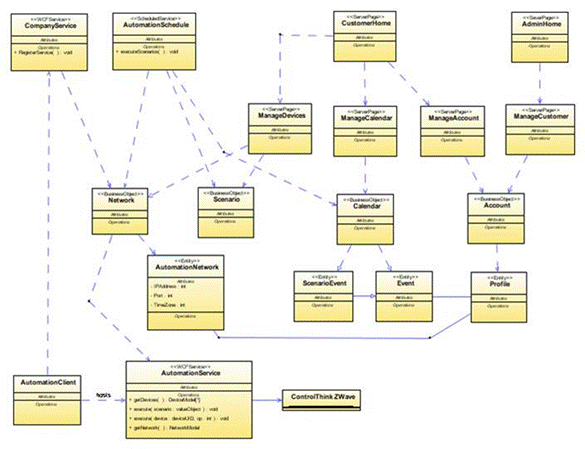
I started using Scrum to break the problem into small pieces. The files I saved tell the story.
Purchased code snippets from July and August 2010, reveal how I hired a contractor to teach me how to develop and install a Windows background service.
A PowerPoint presentation from on 9/17/2010 demonstrates how to register the Windows client application, and another PowerPoint from 8/4/2010 brought my new business partner up to speed.
I was able to hire both her and the contractor because the Small Business Association (SBA) gave me a loan for $50,000. That sounds like a lot of money, but when building complex software, it is not enough. I could see how easy it would be to hack the automation network using fake credentials to access homes without user consent. Evil scenarios of villains terrorizing homeowners tormented me. I needed a lot more than $50,000 to make sure the application was safe. I needed somewhere between $300,000 to $500,000 to get it securely off the ground.
My strategy was to use the $50,000 to develop a prototype to show investors in order to get more funding. My consulting work was a reliable source of income and lucrative enough to pay the loan off if the plan fell through.
At least, that's what I told the bank.
My next consulting contract was with a pharmaceutical company to lead requirements management for their ongoing RUP projects. I worked with them from August 2010 to May 2011.
That job was so stressful, I started grinding my teeth. I still grind my teeth.
Why was it so stressful? The same reason why most projects are stressful. The customer was biting off more than they could chew. There were more features than they had time and resources to develop. But instead of reducing the scope, they found some project managers crouching in the deepest corners of Hades to brow-beat us. Every day, for the first few weeks, the project manager hovered over me.
"Are you done yet?"
Holy hell. No! I just started this job!
Well, I didn't say that. What I actually said was, "No, not yet." But I quickly got my team back on schedule, and I didn't brow-beat anyone to get it done. I simply set an irresistible vision, then loved on them, giving them room and resources to be the best they could be.
On May 14th, 2011, when that contract was finally over, I breathed a huge sigh of relief not knowing that I would soon be facing an extremely inconvenient and long-term unemployment.
Oh no! THE BANK LOAN!!!
If you have just joined us and are wondering what this story is about, start from the beginning and use the next button at the bottom of the post to move forward through the story. I promise it will all make sense.